If you have low self esteem, criticizing others is worse than receiving criticism (as we hate to offend or upset other people)
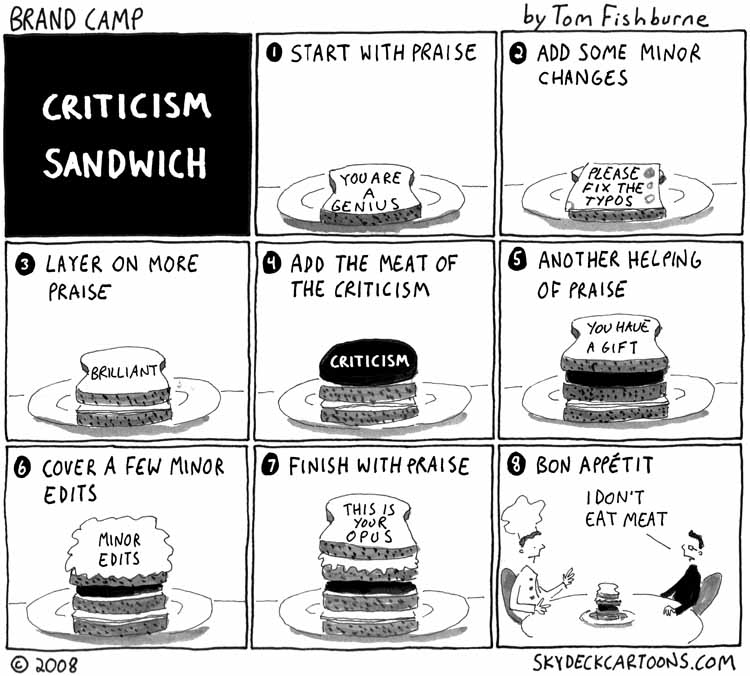
Cartoon kind permission Tom Fishburne
Sadly many adults avoid promotion because they can’t face the prospect of being in authority and having to criticize others. So lets start learning to criticize, or change the behavior of others, when you have to:-
1) Take care when choosing the time and place. Ideally only the person you’re criticizing should be present. Deal with one issue – don’t save up loads of problems for one big battle!
2) Make it as soon after the incident as possible. At least ensure everyone is calm when you start! You cannot control the other persons emotions, but don’t start when you’re fed up and frustrated, or still furiously angry.
3) When preparing its worth using a criticism sandwich, or the hamburger method. Basically you say something nice to the person you’re criticizing, then you insert the criticism, then you end with another thing that’s nice, positive or flatters them.
Praise “You did a good job building rapport with that client. I could tell they were eager to tell you their problem.”
Criticism “Don’t be too quick to jump in. Silences are part of the process, you don’t have to fill them. Unless things are going off track, go with the flow.”
Praise “The client seemed to be relaxed and comfortable. This initial session went really well, and they’ve agreed to a follow up. Excellent.”
Of course, the problem with this method is the criticism can get lost if you overdo the praise as a way of avoiding confrontation or upsetting the other person. And there are times, especially if its a serious issue, when you need to come straight to the point. In the above example if the criticism was…
“Don’t be too quick to jump in, and telling the client to shut up and saying you couldn’t give a toss about their problem isn’t appropriate”
… then you’re moving beyond a sandwich!
4) Criticize the behavior, not the person. Describe whatever behavior needs to be addressed. Don’t start labeling the person – for example as being lazy, inefficient or stupid.
5) Express how you feel. You may not feel anything, but if you do, use the formula:-
I feel …
I feel … when you …
I feel … when you … because…
for example
“I feel angry and let down when you arrive so late because it delays the whole project and wastes everyone else’s time.”
6) Use “I” rather than “you” as much as possible. The word ‘I’ shows you’re in control and that you’ve thought about what you’re saying. It also helps avoid labeling and becoming accusatory.
7) What do you want to happen? Give specific advice about how you expect the other person to now behave or what other action they should now take. Perhaps possible consequences if they don’t change. Be prepared for this before you start.
Don’t forget to revisit some of my past posts on being assertive and saying no. As with assertiveness generally, correct criticizing is about valuing and building relationships, not destroying them.
Bad advice.
The law of contrast (Cialdini – Influence) dictates that after the first layer of praise you will knock them for six with the criticism.
“Pairing” good with bad confuses people. They will never trust your positive comments again if you try a sandwich.
You are better to be upfront and split the person from the behaviour.
“Freddie – I recently observeed you doing XYZ (wrong behaviour) – (their behaviour not the person) and you are aware from our training that the correct behaviour is ABC – can we agree you will do ABC in the future? Do you require further training or are you ok from here on?
James’s last blog post..Feed Your Brain
James, we agree on separating the person from the behavior. As I said in the post, adding praise can backfire if you over do it. But the general principle of combining praise and criticism can work well in many circumstances – and I’m referring to relationships with others as well as management situations.
Personally as a manager it suits my personality and it works well.
David’s last blog post..How to Deliver a Criticism Sandwich
While I can’t argue whether the exact approach is good or bad, I love the comic. And in general, I do think it is better to provide praise and “sandwich” the criticism in the middle, so you begin and end on a high note.
Sid Savaras last blog post..The Curse of the Worst Acceptable Solution
very good advice — and i’m glad you mentioned not going overboard on the praise for fear of losing the message. when very harsh criticism must be delivered, as it sometimes must, there’s a school of thought that advises you to say your piece and walk away. don’t look for a person to respond to criticism about them, at least not in the moment of delivery.
This is a fun post and reminder that there is a way of delivering criticism without crushing someone’s spirits!
Miss Gisele B.
Miss Gisele B.s last blog post..Listen up: obesity for a woman could mean pancreatic cancer
This may represent one tool in the management tool box but as James indicates, it’s not likely to work with everyone.
People who have low self-awareness or are narcissistic (for example) will hear the praise and miss the ‘reprimand.’ Others, including cynics or negative thinkers may miss the positives and only hear the reprimand.
Interesting post!
Syd (I’m not going to call you BMW!) I think thats a very valid point. And as you say, considering the “sandwich” as tool to use as appropriate is probably the best approach.
Davids last blog post..How to Deliver a Criticism Sandwich
What I want to know is whether he eats sandwiches? I think it is key not to make up something just to fit a quota of god and bad. And if somebody is really messing up, it takes a pretty big, sloppy mop. However, I do agree with the principle…if I only I could follow it more often!
David Leonhardt – The Happy Guys last blog post..Happiness in the L.A. Times
While I can’t argue whether the exact approach is good or bad, I love the comic. And in general, I do think it is better to provide praise and “sandwich” the criticism in the middle, so you begin and end on a high note.
Kendals last blog post..Henderson, Nevada
James refers to Robert Cialdini’s book ‘Influence’. Cialdini has collaborated on another book on persuasion recently. It’s called ‘Yes’ and has 50 proven techniques for altering people’s behavior. We can add these 50 to our criticism sandwich skills.
Burt – I’m reading Yes at the moment and I think its brilliant.
Hello David, you may also be interested in Robert Cialdini’s Stanford Dissertation podcast. It covers six influencers. I found it on itunes in the audiobooks section and now have it on my ipod.. Very informative and entertaining.
Another good way is to reformulate your criticism as problem/question.
Instead of saying ‘We don’t have time or money for your project’
your ask ‘How do we get time or money for that project?’
and instead of saying ‘B will newer work’ your ask ‘how can your get B to work’.
Question/criticize as specific and precise as possible.
Relating back to what James said, different methods work well under different circumstances. When criticizing a work of art, this method works beautifully, because the artist EXPECTS and even asks for the criticism, so the praise makes the criticism more palatable. In management situations, however, this can easily backfire, and you may end up in a situation where you can’t offer a genuine compliment, because the recipient is expecting criticism to follow.
Being authentic and looking from the other person’s point of view will never hurt when criticism is necessary.
David, I came upon your blog as I was preparing a program on Emotional Intelligence. Thank you for taking the time to share your wisdom. I’m about your age and I recognize it’s time for me to give back in a similar fashion. “At last, someone wants my opinion!” That being said, when I saw the Title of this post I HAD to read it! I’ve worked for 3 fairly large global organizations working my way through the ranks and have spent the last 20 years in the OD field. I now find myself facilitating programs and interventions to fairly senior people (sometimes intimidating — I’m working on self-esteem even now!). I thought I’d share with you what we have come to call the criticism sandwich. Here it’s known as the “Shit-filled Twinkie”. Obviously we don’t approve of finding 2 slices of bread in which to sandwich constructive feedback! (I’m smiling right now). However, and this is important — I truly believe it’s necessary to send the individual on their way knowing that you believe they have the power and the capability to make changes in their behaviour, so perhaps this becomes an upside down open-faced sandwich!
Keep up the great work! I’ll be back. Sincerely, Paul (Toronto, Canada)
Hmmm. I wonder which would be easier to digest: a criticism sandwich or humble pie?